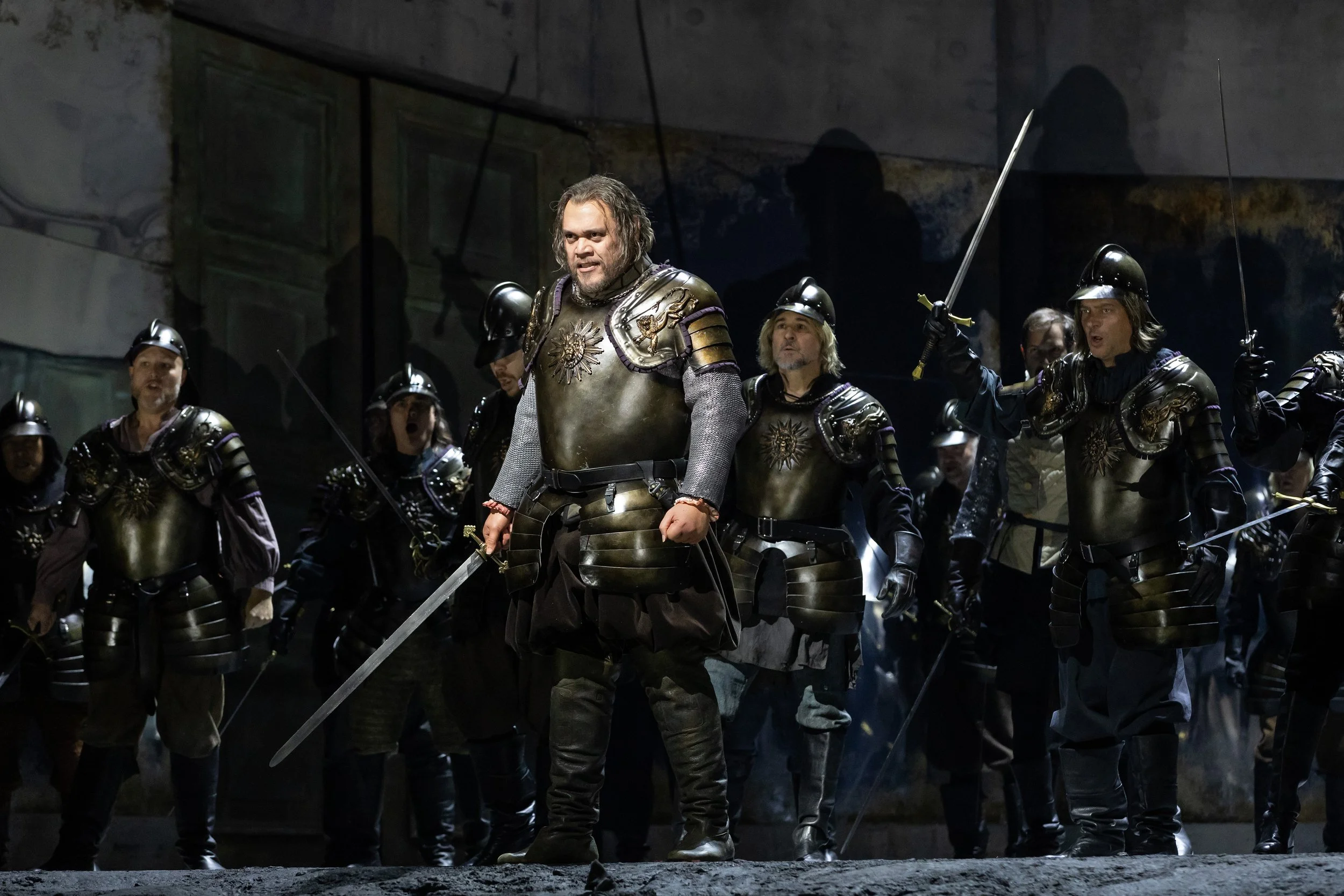
Photo: Marty Sohl / Met Opera
Early in the evening, a man walks back to his wife with blood on his hands and, rather than hiding it, wipes it down the front of her white dress. I have been turning that image over ever since. He confesses and marks her in the same movement, making her a co-owner of the crime, and this staging lets the moment land with terrible clarity. Add the heartbreak in the singing and you have the point at which I knew this Macbeth would not look away.
Macbeth hardly needs an introduction. For more than four hundred years it has been retold, borrowed from and parodied, and its fingerprints are all over the stories we still tell: the prophecy that nudges a man towards his fate, the ambitious partner whispering in his ear, the ruler whose grip on power tightens as his grip on himself loosens. Plenty of people who have never sat through the play use its phrases without knowing where they came from. It has become an institution, and institutions are tricky things to stage, because everyone arrives with their own version already in their head.
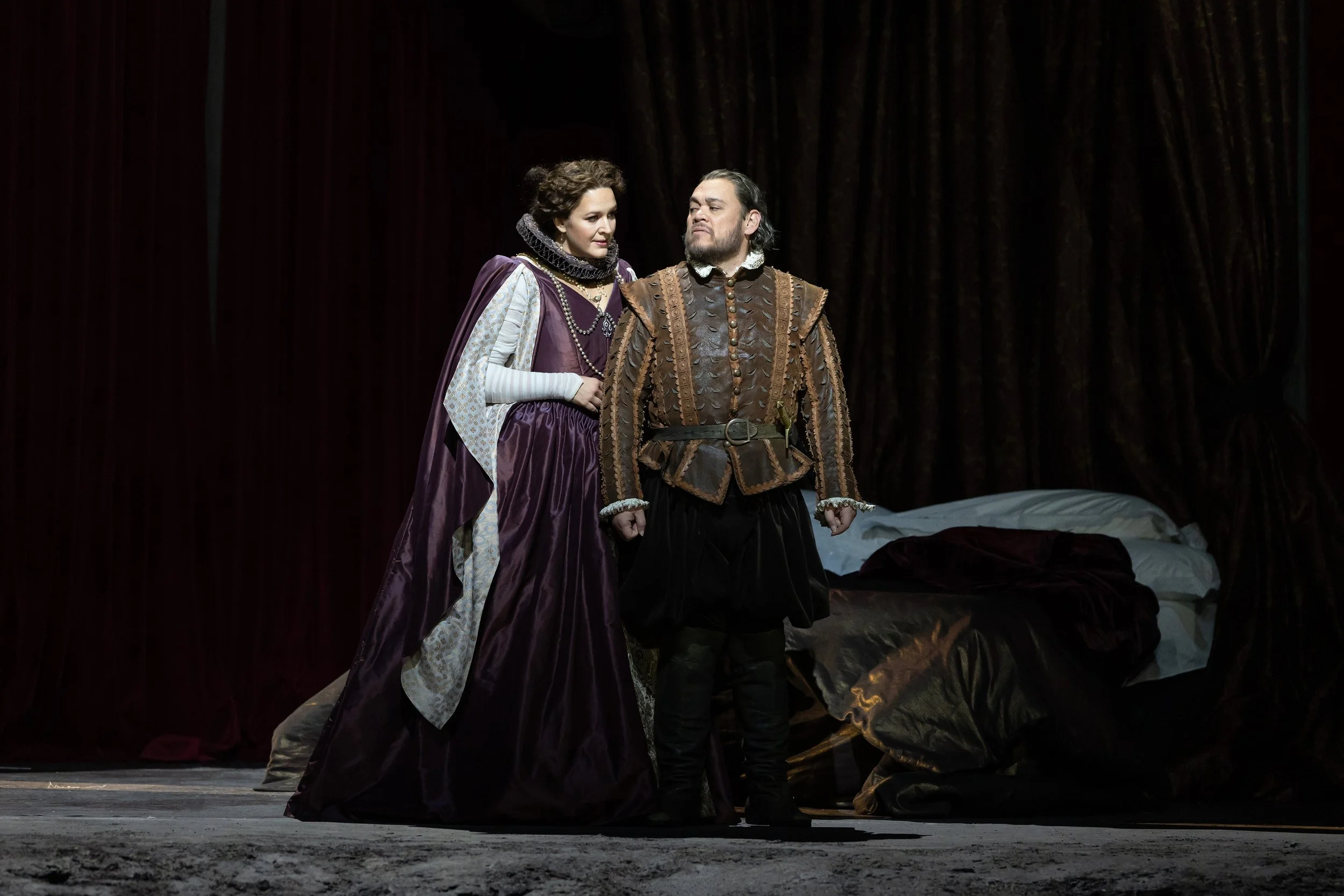
Photo: Marty Sohl / Met Opera
Verdi’s Shakespeare
Verdi first tackled it in 1847, the earliest of his three Shakespeare operas, and what strikes me is how clearly he loved the source material. He does not tidy the play up or soften its edges. Instead he lets the music do the descending. Early on, the couple’s ambition has a bright, restless energy, and you can almost understand its appeal. As the bodies pile up, the sound darkens and frays, and by the time we reach Lady Macbeth’s sleepwalking, the score has followed her all the way to the edge of her sanity. Under Yannick Nézet-Séguin the orchestra tracks this slide with real attention, so that the psychology of the story lives as much in the pit as on the stage. All the while it remains unmistakably Verdi, with his own instincts for melody and theatrical pace running through every scene.
I will admit that I still find it slightly strange to hear a story so steeped in Scottish mist and stone sung in Italian. A part of me keeps listening for a burr in the voices. Then the orchestra swells, the subtitles keep pace, and the thought quietly dissolves, because the drama is so alive in Verdi’s phrasing that geography stops mattering. Opera has always travelled this way, borrowing stories from everywhere and dressing them in its own language, and an Italian composer finding his own voice inside a Shakespearean tragedy is a large part of what makes this piece what it is.
Watching it on a cinema screen suits the material rather well. The cameras take you close enough to read the fear and calculation on a face, which is exactly where this story lives, while the sound fills the room with the full weight of the orchestra and chorus. Sitting in the dark with a room full of strangers while a murder unfolds in front of you is a very fitting way to meet this particular tale.
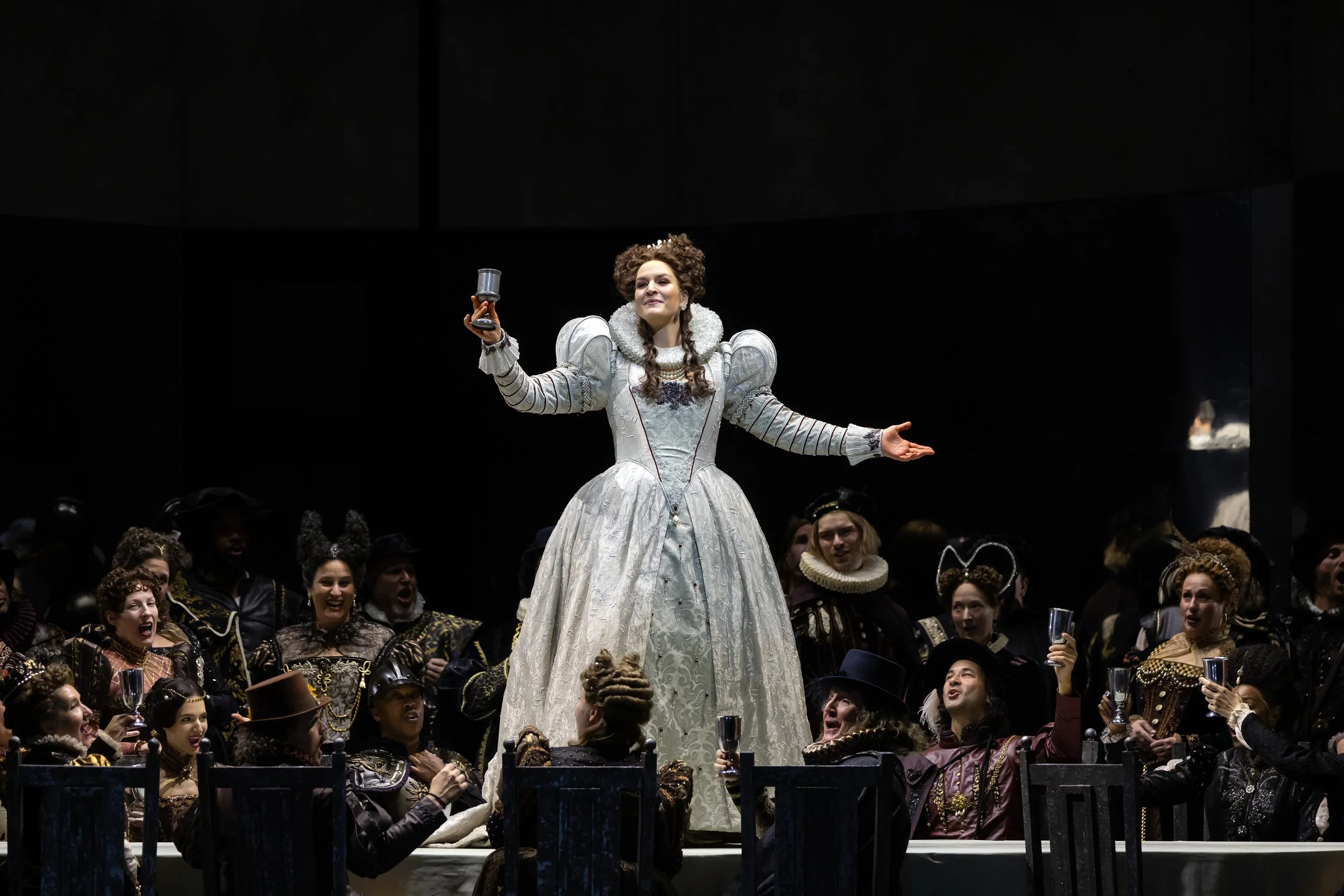
Photo: Marty Sohl / Met Opera
Witches, blood and a guilty conscience
Verdi gives the witches to a full chorus rather than the trio Shakespeare wrote, and director Louisa Proske makes the most of that choice. These witches are genuinely frightening. They bring a menace and a sense of rot to the stage that made my skin crawl, and I mean that as the highest praise. It is easy for supernatural figures in opera to drift into pantomime, all cauldrons and cackling. Here they felt older and more patient than any human ambition, which is far more disturbing. Their scenes set the tone for the whole evening: this is a world where evil is simply in the air, and Macbeth and his wife are walking into it with their eyes open.
Against that backdrop, Quinn Kelsey and Lise Davidsen sing the couple with the kind of power and commitment that make their ruin feel both inevitable and sad. The singing was excellent, as one has come to expect from the Met, but what stayed with me was how much feeling sat inside the sound. In the scene with the blood and the dress, the voices carry the horror and the grief together, and you are left unsure whether to be repulsed or to pity them. That is a difficult balance, and this production holds it beautifully.
The image of that white dress also gives the evening its backbone. When the story arrives at Lady Macbeth’s sleepwalking, the guilt she took on in that first terrible night finally catches up with her, and the stain she cannot wash away feels like something we have watched being made. Stagecraft and music work together to remind us that a guilty conscience is the one adversary no crown or army can defeat. Macbeth may kill his way to the throne, but he never manages to kill the voice inside his own head.
That is why the story endures. Power and greed are old companions, and we keep meeting new versions of the same bargain: the justification that sounds reasonable in the moment, the first compromise that makes the second one easier, the price that arrives later than expected but always arrives. A tale about ambition and conscience written more than four centuries ago, set to music more than a century and a half old, still feels uncomfortably current.
For anyone who has been curious about opera but unsure where to begin, Macbeth is a very good place to start. You may well know the story already, the emotions are big and clear, and nobody needs to speak Italian to follow a man losing his soul. And for those who know the play well, there is real pleasure in seeing what Verdi, and this team, do with it. Two screenings are all that remain, and this is one I would not want you to miss.
Macbeth runs at Ster Kinekor Theatres on the 1st and 3rd of November 2026.