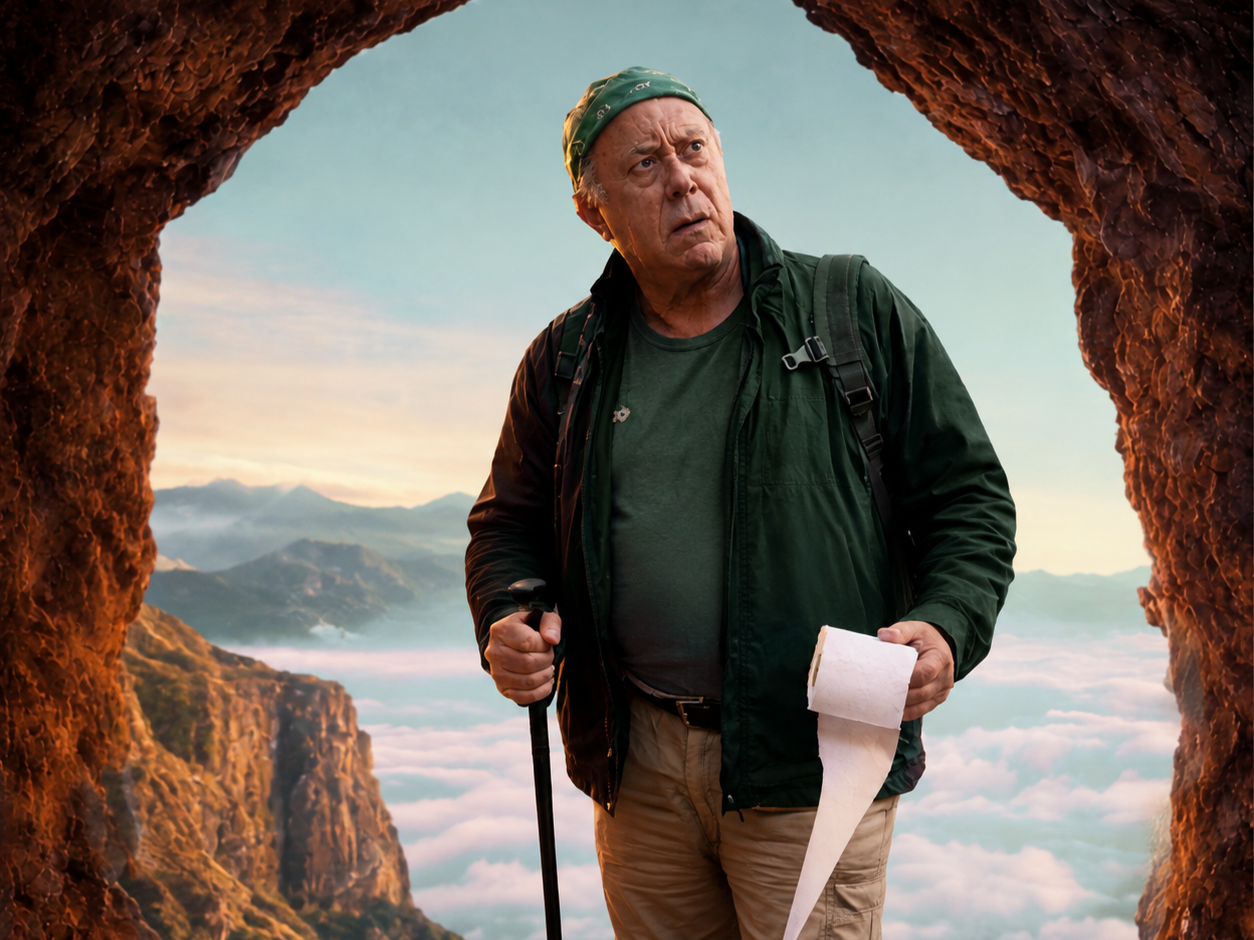
What would surface if you were cut off from your phone, your calendar, and every other distraction, with nothing to do but sit with your own thoughts for a few days? That's the question at the heart of Roland's Cave, which strands its wealthy Springbok-German protagonist in a Drakensberg cave and watches, with real tenderness and a good deal of humour, as he starts answering it.
The premise is disarmingly simple. Roland gets caught out on a hike and takes shelter from the weather in a cave. What begins as an inconvenience becomes something closer to a reckoning. Cut off from meetings and messages and the noise that fills most of our waking hours, Roland is left with nothing but his own voice and whatever it is he's been avoiding hearing. It's not a complicated setup, and that's precisely its strength. Strip away the distractions and what's left is a man talking to himself, and somewhere underneath the rambling, a whole world of buried feeling starts to surface.
Jürgen Hellberg wrote the piece himself, and it shows in the best possible way. There's a lived-in quality to Roland's voice, an ease with the character's contradictions, that only comes from an actor who has spent real time inside a role before ever stepping in front of an audience with it. Hellberg himself walked away from a solo stage career decades ago to build a name in South African television and film, so there's an unmistakable echo of his own story in Roland's reckoning with the parts of himself he set aside to get ahead in the world. That kind of personal resonance is difficult to fake, and it gives the performance a sincerity that carries it through its quieter, more exposed moments.
What struck me most was the humour. A play built around loneliness and self-confrontation could easily tip into something heavy-handed or self-pitying, but Roland's Cave never loses its lightness of touch. The jokes land because they come from a place of recognition rather than deflection, and they give the audience permission to laugh at Roland even as they're starting to see themselves in him. It's a difficult balance to strike in a solo show, where every beat of tone rests entirely on one performer's shoulders, and Hellberg manages it with a warmth that keeps the piece from ever feeling like an ordeal to sit through.
The setting matters too. This isn't a story that could happen anywhere. The Drakensberg is doing real work here, not just as scenery but as a kind of moral landscape, vast and indifferent and entirely South African. There's something in the specificity of that mountain silence, the particular quality of being alone in this country's wide open spaces, that feels instantly recognisable to a local audience. Roland's crisis is a universal one dressed in distinctly South African clothing, and that rootedness gives the play a sense of place that a more generic setting would have sanded away.
Shireen Hollier's direction keeps the staging unfussy, trusting the writing and the performance to do the heavy lifting rather than reaching for spectacle. For the most part that restraint pays off. Where the production could still grow is in its pacing. There are stretches where the energy sits at a similar register for long enough that the journey starts to feel a little flat, a little short on the peaks and valleys that might have sharpened the emotional turns even further. A monologue of this length and intensity benefits from more dramatic variation, moments that slow right down against others that erupt, so the audience feels the shifts in Roland's internal weather rather than simply being told about them. It's a minor note on a production that otherwise commits fully to what it's trying to do, and Hellberg's total investment in the role, the sense that he's leaving absolutely everything out there on the stage, goes a long way towards carrying the audience through any flatter patches.
Because that commitment is really the heart of what makes Roland's Cave work. This is a performer holding nothing back, wringing every ounce of feeling out of a text he clearly believes in, and there's something moving about watching someone give that much of themselves to an audience of strangers. You don't need to have made a fortune or hiked the Drakensberg to recognise the shape of what Roland is going through. Most of us know what it is to bury the parts of ourselves that once felt essential, the music we stopped making, the connections we let go slack, in service of a life that looks successful from the outside and feels hollow from within.
By the end, I found myself thinking that perhaps we could all use a version of Roland's cave. Not literally, though I imagine a weekend away from our phones wouldn't hurt any of us, but that enforced stillness, that space with nothing to do but sit with our own thoughts and take honest stock of where we've ended up. It's a generous, unpretentious piece of theatre, funny where it needs to be and unflinching where it counts, and it leaves you with a genuinely useful question to carry out of the theatre: what have you been avoiding hearing, and what might it take to finally listen?