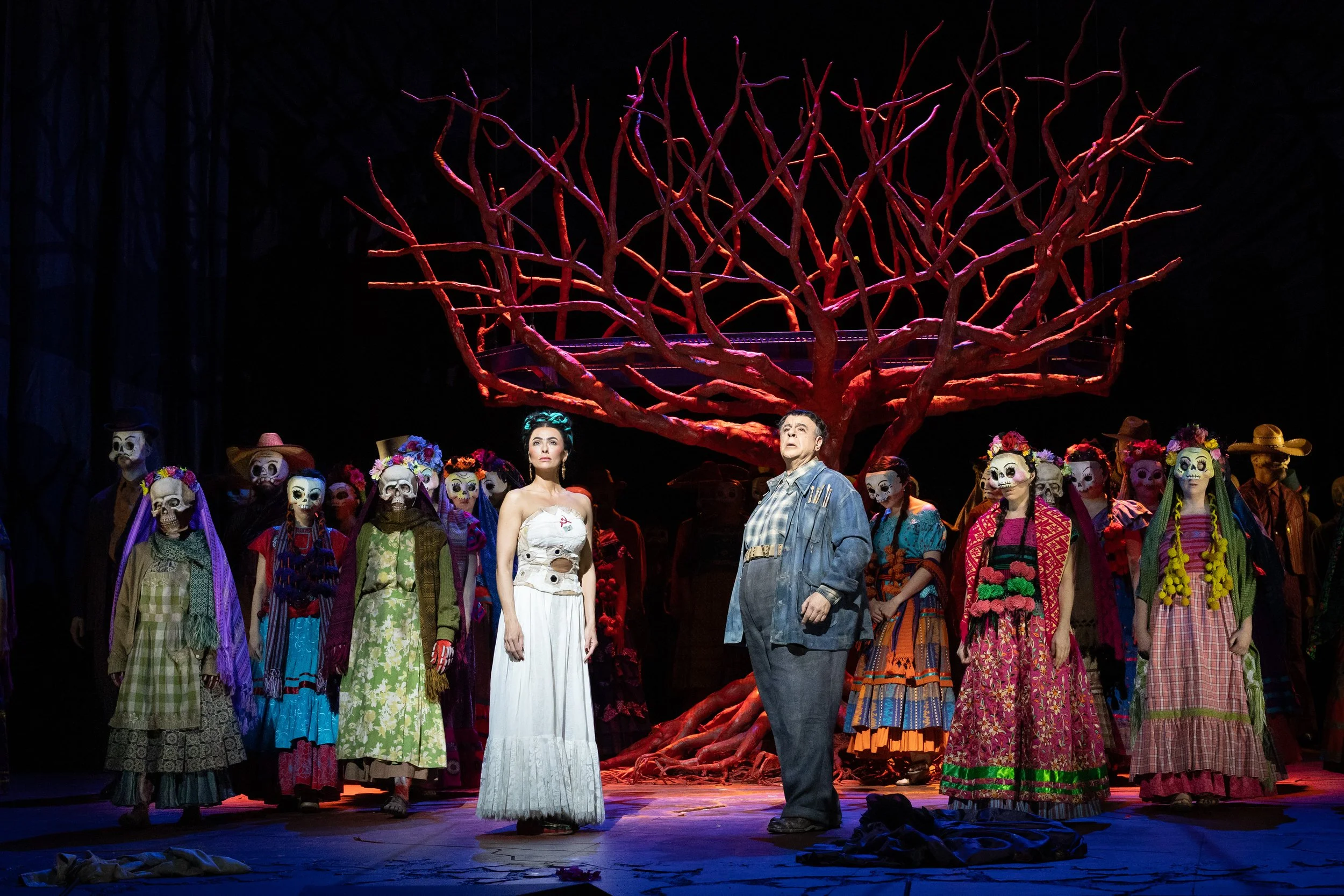
Photo: Marty Sohl / Met Opera
I've had Anaïs Mitchell's Hadestown on repeat this week, that gorgeous, aching retelling of Orpheus and Eurydice dressed in folk and jazz and the smoke of the underworld. So there was something almost fated about sitting down at Cinema Nouveau to watch El Último Sueño de Frida y Diego, Gabriela Lena Frank's extraordinary first opera, which takes that same ancient myth, turns it entirely on its head, and transplants it into the colour-drenched world of two of Mexico's greatest artists. I should confess upfront: I am still very much a student of opera, and this was only my third encounter with the form. But I have come to believe that the best art does not require expertise to move you, and this opera moved me considerably. In the original Orpheus myth, it is the man who descends into the underworld to retrieve the woman he loves. Frank and her librettist, Pulitzer Prize-winning playwright Nilo Cruz, do something far more interesting: they send the woman back.
Frida Kahlo has died. In Mictlán, the Aztec underworld, she has found something she never quite had in life: peace. Free from the physical suffering that defined her earthly existence, free from the turbulence of her marriage to Diego Rivera, she has, at last, arrived somewhere still and whole. The opera begins here, in that stillness, and it is La Catrina, the skeletal Keeper of the Dead, who disturbs it. Diego, alive and lonely, is summoning Frida on the Day of the Dead, and Catrina insists she must go to him.
What follows over nearly three hours is one of the most visually and sonically rich operatic experiences I have encountered. Deborah Colker's production is a feast of movement and image. The Brazilian director and choreographer, best known for the 2016 Rio Olympics opening ceremony, brings an extraordinary physical vocabulary to the work. The chorus of the dead move with fluid, acrobatic precision, the skeleton figures among them forming shapes that are at once uncanny and graceful, surreal tableaux that feel lifted directly from Kahlo's paintings. There is a moment early in the opera when the earth of the underworld seems to crack and shift, an image at once simple and breathtaking, and it sets the visual register for everything that follows: this is a world in which the boundary between the living and the dead is porous, painterly, and strangely beautiful.
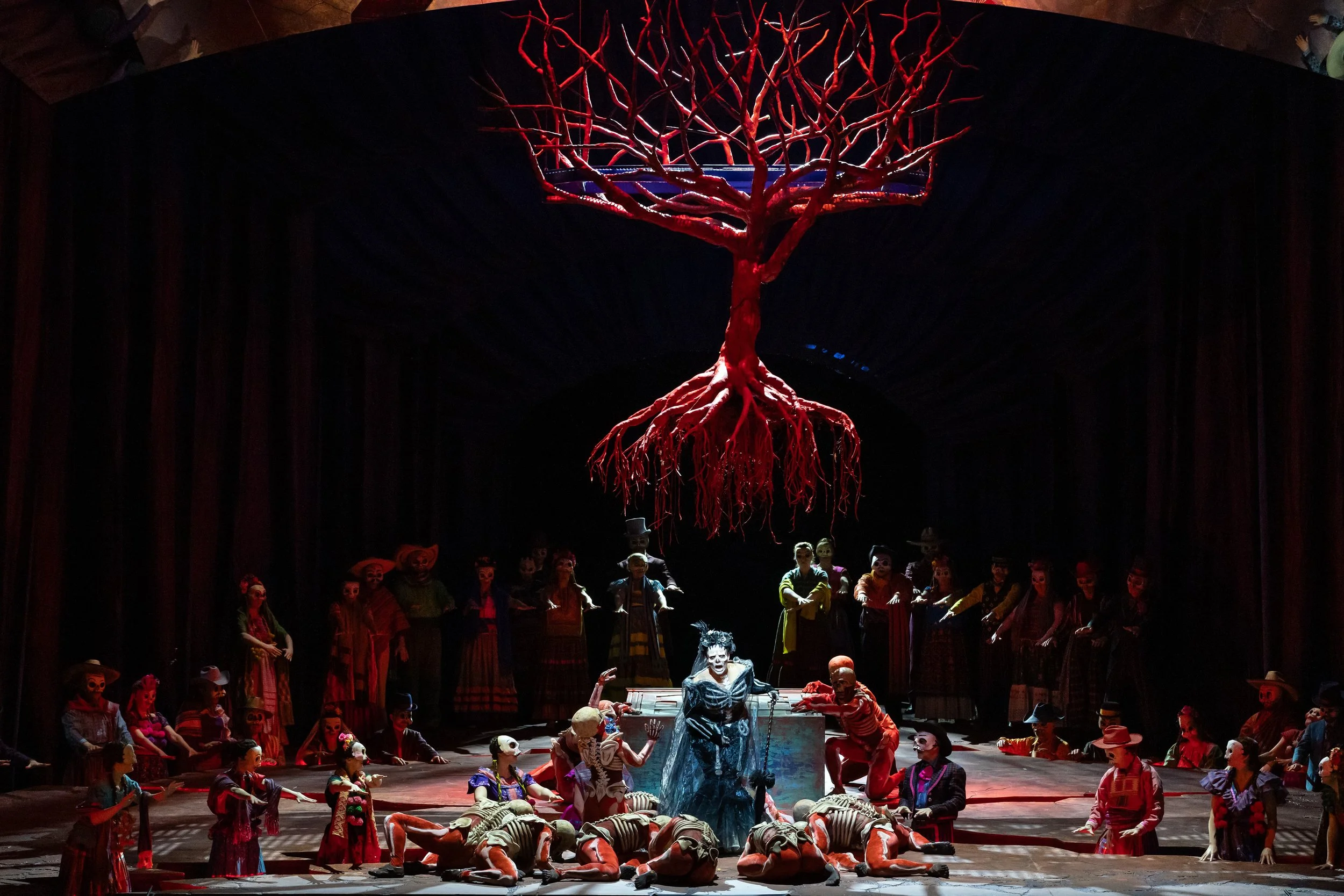
Photo: Marty Sohl / Met Opera
A Score Built from Two Worlds
Gabriela Lena Frank, who was awarded the Pulitzer Prize in Music in 2026, brings to this opera a compositional sensibility that is genuinely unlike anything else in the current repertoire. The score is a richly layered construction that draws equally on the Western operatic tradition and on the sounds of Latin America. The marimba, Mexico's national instrument, threads through the orchestration like a pulse, sometimes foregrounded, sometimes barely audible beneath the larger ensemble. Mariachi rhythms surface and dissolve. There is a quality to Frank's writing that critics have called "bursting with colour and fresh individuality," and hearing it come through the cinema's speakers, one understands why. It is contemporary music that does not apologise for its accessibility, a score that moves between the eerily atmospheric and the exuberantly melodic with a confidence that belies the fact that this is a first opera.
The cast assembled for this Met premiere is exceptional. Isabel Leonard is a commanding and deeply human Frida, her rich mezzo-soprano capturing both the steeliness and the vulnerability of a woman who has made her peace with death and is not entirely sure she wants to relinquish it. Carlos Álvarez brings considerable baritone weight to Diego Rivera, a man simultaneously grandiose and broken, his voice carrying the particular sadness of someone who has outlived the person who made sense of his life.
But the two performances that most electrify the evening belong to the supporting roles. Gabriella Reyes as La Catrina is a revelation. Tall, spectral, costumed in bone and dark tulle, she uses every resource at her command, voice, body, presence, to fully inhabit a character who is both terrifying and darkly comic. Her soprano has a quality that is simultaneously luxurious and precise, and she seems to understand, instinctively, that Catrina's power lies not in menace but in absolute authority. This is a keeper of the dead who knows exactly what she is doing, and Reyes makes that unnerving certainty completely persuasive.
Then there is Nils Wanderer, making his Met debut as Leonardo, a young actor in the underworld who wants nothing more than to return to the living world dressed as Greta Garbo, in tribute to an admirer who adores her. It is an unusual role in an unusual opera, and Wanderer inhabits it with a quality that can only be described as spellbinding. The countertenor voice, already an instrument that carries an innate quality of otherworldliness, takes on an added resonance here: Leonardo exists at the boundary between masculine and feminine, between the living and the dead, and Wanderer's voice reflects that liminality with every phrase. There is a moment when he shifts from his countertenor register down into natural tenor and back again, a brief, almost casual demonstration of vocal range that is, in fact, a breathtaking sleight of hand. When he finally appears in Garbo's famous green velvet costume, the effect is joyous and strange and entirely right.
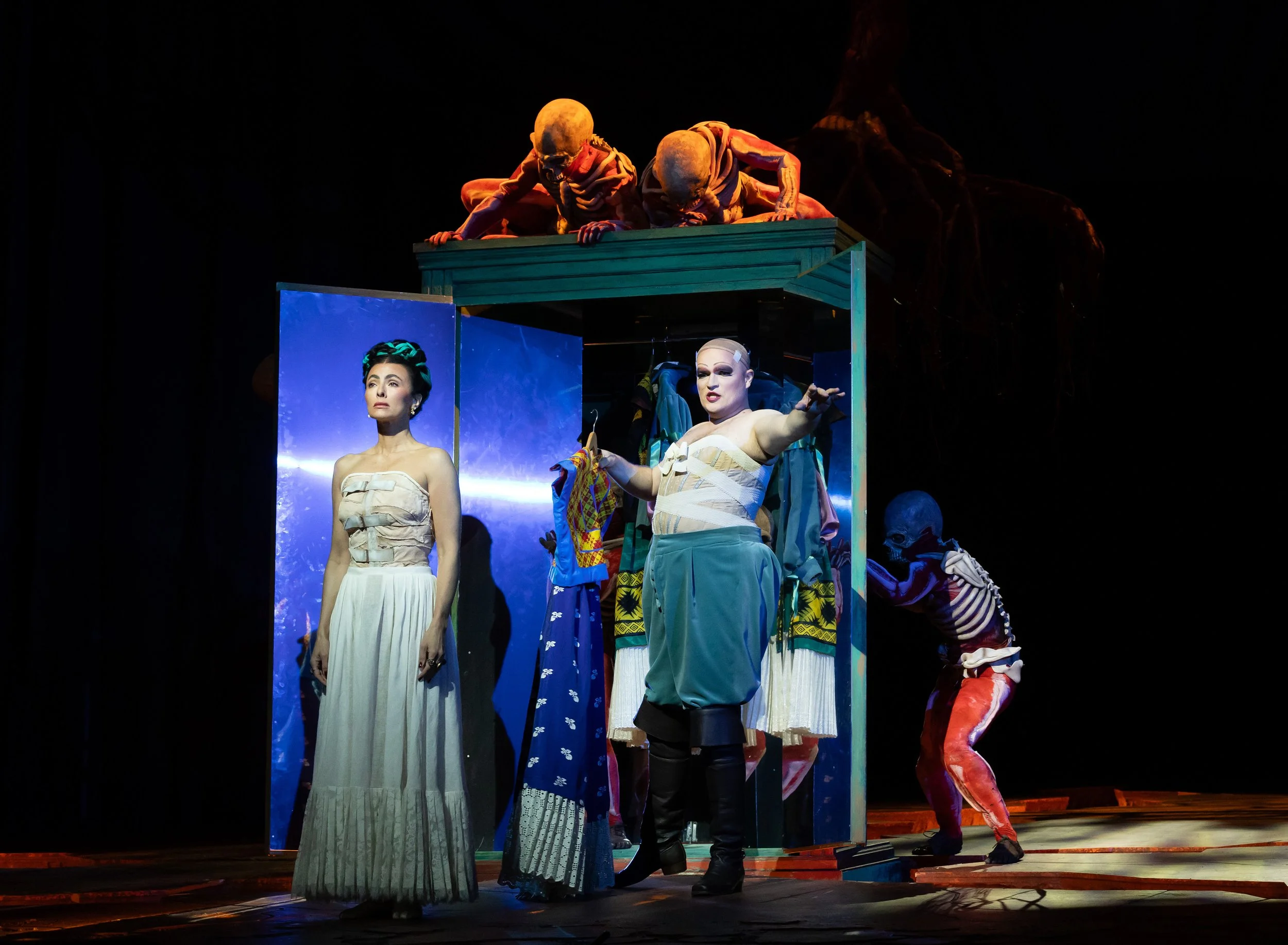
Photo: Marty Sohl / Met Opera
Art as the Only Immortality
What the opera is ultimately about, beneath all the colour and spectacle and mythological architecture, is something simpler and more profound. Frida Kahlo spent most of her adult life imprisoned inside a body that was constantly betraying her. The bus accident of her youth left her with injuries that never fully healed; she lived in almost constant pain, endured dozens of operations, and spent long months immobilised. And yet from that confinement she produced some of the most vivid and emotionally direct paintings in the history of art. The opera understands this paradox deeply. Frida in Mictlán is free in a way she never was in life, and the drama of her return to the living world is partly the drama of choosing whether to feel again, to risk pain in order to feel beauty.
The resolution, when it comes, is not comfortable. Frida, forbidden to touch Diego during her single day among the living, eventually breaks that prohibition, and the memories of pain and hurt flood back. And yet, even in that moment of returning suffering, there is clarity. Art is the only thing that outlasts death. The final image of the opera is breathtaking, and I will not describe it here, because it earns its impact through everything that precedes it.
In a season when the Met: Live in HD series has offered us the familiar and the beloved, it is fitting that it closes with something genuinely new: a contemporary opera, written in Spanish, rooted in Latin American culture and mythology, that makes no concessions to convention and no apologies for its ambitions. Frank and Cruz have made something that belongs entirely to the tradition they are drawing on and that also, unmistakably, belongs to this moment. That is not a common achievement. It deserves to be seen.