Nobody Told Me: Theatre as Historical Reckoning
Credit: Thom Pierce
It’s difficult not to feel some exhaustion when you bear witness to history's darkest chapters. It's not the comfortable fatigue of a satisfying evening at the theatre, but something rawer, a weariness that settles in the chest and refuses easy consolation. Nobody Told Me, Luc Albinski's deeply personal debut as a playwright, understands this exhaustion intimately.
The production, which is running at Theatre on the Square, grapples with inherited trauma, buried identity, and the impossible moral terrain of the Warsaw Ghetto's medical community during the Holocaust. It's an ambitious undertaking, made all the more remarkable by the fact that this isn't merely historical drama, it's Albinski's own grandmother's story, told through the lens of his mother Wanda's childhood memories and his own belated discovery of his Jewish heritage.
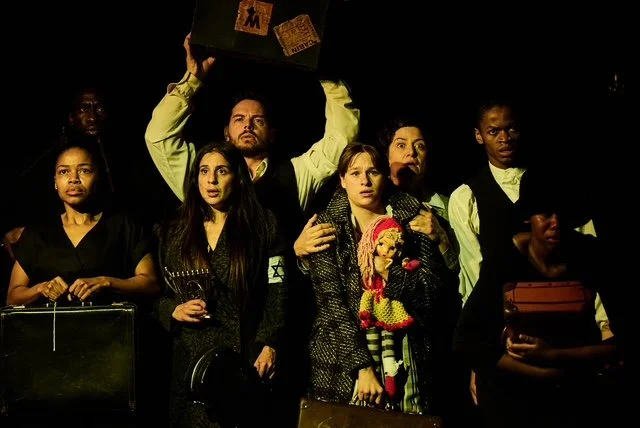
What strikes you first about this production is its physical vitality. Director Ilina Perianova has assembled a substantial cast that moves with purposeful energy across a minimalistic set, breaking the usual boundaries between stage and audience. Bodies become furniture, walls, trains. The actors remain visible throughout, morphing between roles in a style where the act of remembering is itself a constructed, communal event. There's something profoundly right about this approach for a story so concerned with what we choose to show and what we choose to hide.
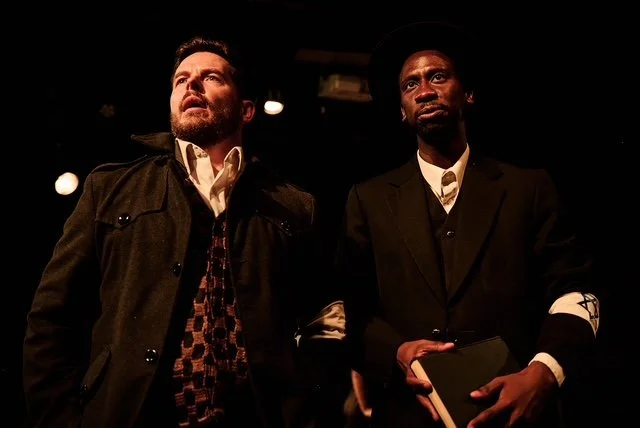
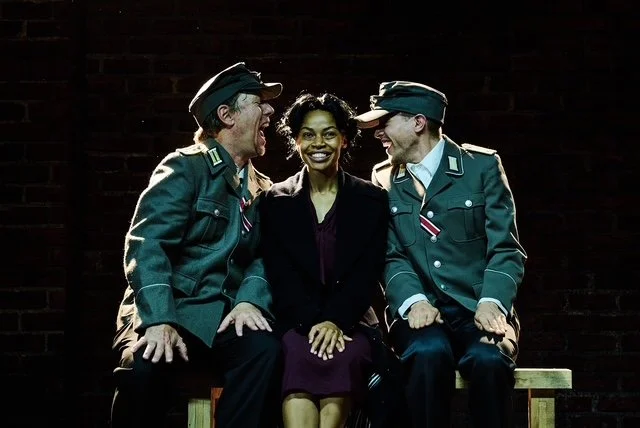
The stagecraft deserves particular mention. In an era when many productions rely on technological spectacle, there's real invention here in how human bodies create the world of 1930s and 1940s Warsaw. Vicky Friedman's choreography gives physical form to emotional and historical chaos, whilst Gwendi Botha-Gourley's period costumes ground us in specific time and place. These choices are essential to how the production communicates the disorientation of living through catastrophe.
The performances also carry considerable weight. This is emotionally demanding material, asking actors to inhabit people facing choices for which there are no good answers, and the ensemble rises to meet that challenge with commitment and sincerity. There's a rawness to the work that feels earned rather than performed, particularly in the portrayal of Dr Halina Rotstein, the Jewish physician who chose to board the train to Treblinka alongside her patients rather than abandon them.
Credit: Thom Pierce
The Weight of Unrelenting Intensity
Yet for all its strengths, Nobody Told Me sometimes struggles under the weight of its own seriousness. The production maintains such a consistently intense pitch that it begins to work against itself. Horror, when unrelieved, can paradoxically become numbing. The play might have benefitted from what the Ghetto's inhabitants must have desperately sought: small moments of respite and fragments of ordinary human connection that make the extraordinary suffering more rather than less powerful.
This isn't to suggest the material requires comic relief or false lightness. Rather, it's a question of dramatic architecture. The most devastating moments in theatre often gain their power from contrast; from the brief illusion of safety before it's shattered, from the ordinary gesture that reminds us what's at stake. Without variation in emotional temperature, even the most harrowing revelations can lose their capacity to shock us into attention.
The narrative structure itself mirrors the chaos it depicts. That confusion and fragmentation are appropriate responses to trauma, and the audience's disorientation reflects the characters' own desperate uncertainty. What holds it all together though is a wonderful musical score from Jeanne Zaidel-Rudolph's which offers a kind of emotional foundation that helps orient us when the narrative threatens to overwhelm. The music doesn't explain or comment; it simply holds space, creating a sonic landscape within which this difficult history can be examined.
Credit: Thom Pierce
Theatre as Moral Necessity
What redeems any reservations about pacing or structure is the fundamental importance of what Nobody Told Me attempts to do. We live in a moment when the language of "us versus them" has resurged with alarming force, when tribal identities are weaponised, when some lives are deemed to matter less than others. Albinski's play arrives as a necessary reminder of where such thinking leads when left unchecked.
The production's central concern (what we inherit, what we hide, and how untold stories continue to shape the present) resonates far beyond its historical setting. In making visible the private, emotional landscape behind public atrocity, the work asks us to remember not just that the Holocaust happened, but that it happened to individuals with families, professions, friendships, daily routines. Dr Halina Rotstein wasn't a statistic; she was a doctor, a mother of four, and a woman who maintained her commitment to healing even when the world around her had abandoned all pretence of humanity.
Nobody Told Me is not an easy evening at the theatre. It makes demands of its audience that some may find challenging. But perhaps that's precisely the point. We live in comfortable times, at least for those of us privileged enough to spend evenings at the theatre. We can choose to look away from historical horror, to maintain our equilibrium, to avoid exhaustion. The people whose stories Albinski tells had no such luxury.
The production reminds us that theatre, at its best, isn't merely entertainment. It's a space where communities gather to reckon with truths too large for individual contemplation, where inherited silence can finally be spoken aloud, where the act of remembering becomes a moral imperative. In that sense, Nobody Told Me succeeds at something more important than crafting a perfectly balanced drama. It creates space for necessary conversation about what we owe the dead, what we owe each other, and what we risk when we allow history to become comfortably distant.
One leaves the theatre tired, yes — but perhaps that tiredness is itself a kind of tribute, a small portion of the exhaustion carried by those who lived through these events. If we cannot bear to sit through two hours of discomfort, how can we presume to understand what they endured? This is theatre that refuses to comfort, and in our current moment, that refusal may be exactly what we need.