Tristan und Isolde: A Newcomer's Guide to Five Hours of Bliss
Five hours and twelve minutes. When I saw that number printed on the screening details for Wagner's Tristan und Isolde, I felt a quiet panic. I have attended one other opera in Johannesburg, a single prior dipping of the toe. This was something else entirely, a plunge into the deep end, a full day surrendered to a single work of art. I sat in the dark at Cinema Nouveau in Rosebank and thought: what have I done?
By the end, I didn't want it to stop.
I have been thinking lately about the quality of my attention. Like many people, I have grown accustomed to the short scroll, the skipped trailer, the content consumed in snatches. I have been making a deliberate effort to return to longer forms, books read rather than sampled, films watched through rather than abandoned, and so when I was invited to the media screening of the Metropolitan Opera's new production of Tristan und Isolde, I decided to treat it as a test as much as a treat. What I did not anticipate was how completely the music would make the question of distraction irrelevant. Wagner doesn't just ask for your attention. He takes it, quietly and absolutely, and does not give it back.
Music That Changed the World
Before attending, I did my research. I am glad I did, because Tristan und Isolde turns out to be one of the most significant musical events in the history of Western culture, a claim that sounds hyperbolic until you understand what Wagner actually did. The opera opens with what has become known simply as "the Tristan chord," a famously unresolved dissonance that, from the very first bars of the prelude, refuses to settle. In the tradition of Western harmony, dissonance resolves to consonance: tension finds release, instability finds rest. Wagner denies this, repeatedly and deliberately, for nearly four and a half hours. The chord does not fully resolve until the final minutes of the opera, when Isolde sings her last aria, the Liebestod, and dies. Composers from Debussy to Schoenberg to Mahler all subsequently charted their own courses in response to what Wagner had done here, some in imitation and some in deliberate rejection. The opera did not merely push the boundaries of classical music. It broke them, and the pieces scattered across the entire twentieth century.
Knowing this made the experience of listening entirely different. The prelude, which opens in yearning and never quite arrives anywhere, ceased to be abstract and became an embodiment of the story itself: two people who want each other completely and cannot have each other, in this life, on these terms. The music is the feeling. It does not describe longing. It is longing, structured, sustained and drawn out across an orchestra until it becomes almost unbearable in the most exquisite way. When the final resolution came, those warm, full chords settling at last like sunlight breaking through after hours of cloud, I felt it physically. My eyes were wet. My skin was covered in goosebumps. It was one of the most extraordinary musical experiences I have had.
Voices Without Walls
I sing with the Symphony Choir of Johannesburg. I know something, in a modest and amateur way, about what it means to try and project your voice over an orchestra. With over a hundred voices behind you, it is still an effort. The notion that a single human being, without amplification or enhancement of any kind, can not only carry a melody above a full symphony orchestra but shape it, colour it, and sustain it across five hours, remains one of the most astonishing things I have encountered in music. Going down the rabbit hole of research into how opera singers train, the years of physical conditioning, the extraordinary technical mastery of breath and resonance, the discipline required to be ready to do this night after night, only deepened my astonishment. It is an athletic and artistic feat for which we have no real equivalent in popular music.
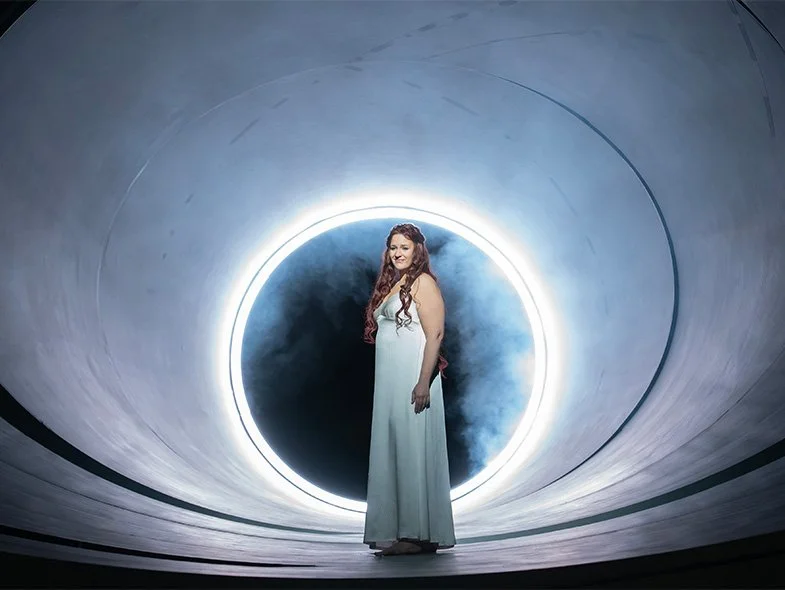
The cast in this production is, by any standard, exceptional. Norwegian soprano Lise Davidsen makes her company role debut as Isolde, and from her first scene, it is clear that this is a voice of rare and almost frightening power, dark, brilliant, capable of both titanic force and extraordinary delicacy. Tenor Michael Spyres brings something unusual to Tristan: a voice that begins with the warmth and intimacy of a Lieder singer and builds, act by act, into something genuinely heroic. By the time his Act III monologue arrived, Tristan delirious, feverish, undone, it rang out with a freedom and brilliance that stopped the breath. Mezzo-soprano Ekaterina Gubanova as Brangäne and bass-baritone Ryan Speedo Green as the betrayed and heartbroken King Marke completed a principal cast of remarkable quality.
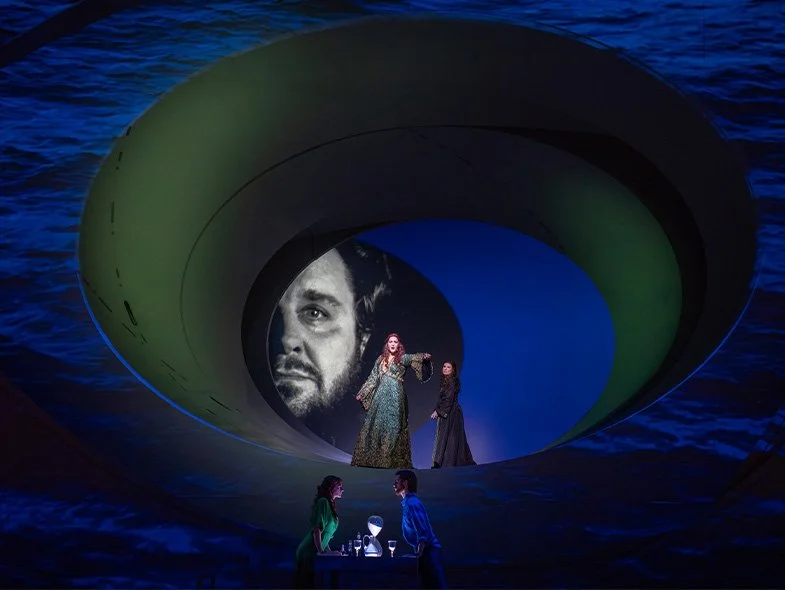
I have read some of the more mixed responses from seasoned opera-goers to Yuval Sharon's new production. The staging, which unfolds across two planes simultaneously with a shifting oval tunnel above and a long dining table below, and which culminates in an onstage birth just before the Liebestod, has divided opinion. Some found it visually arresting and conceptually rich, a meditation on cycles of death and rebirth. Others were frustrated by its complexity. I can only speak as someone encountering this work for the first time on screen, and for me, the visual world was absorbing and strange in the best sense, full of images I am still turning over. What the HD camera did, and this is one of the great gifts of the Met: Live in HD format, was bring me close to these performances in a way that no seat in any theatre could have managed. The closeups of Davidsen's face during the Liebestod, the attention drawn to Spyres's extraordinary physical commitment during Act III, the ability to read the emotion in a gesture or a glance: these are not compromises on the live experience. In some respects, they are enhancements of it.
Opera at the Cinema, with Popcorn
There is something wonderfully democratic about watching a Metropolitan Opera production from a cinema seat in Johannesburg, popcorn in hand, while it is simultaneously being watched in concert halls and cinemas across sixty countries. A production of this scale, with these artists, at this moment in operatic history, would ordinarily require a flight to New York and a ticket price to make you flinch. The Met: Live in HD series makes it possible for the rest of the world to participate, and not as a second-best substitute but as a genuinely privileged viewing experience.
I know that the idea of opera at the cinema is not for everyone. I know there are purists who would wince at the popcorn, the reclining seats, the suburban setting. But I find that objection less interesting than its opposite: that more people should try it. Not as a cultural obligation, not as improving medicine, but because there is music in the world that will outlast all of us, that has already outlasted more than a century and a half, and that does something to your nervous system and your emotions that no streaming algorithm can replicate. Tristan und Isolde is that music. Wagner himself, looking back on it, said he could barely understand how he had done such a thing. It still feels that way.
I walked out of that cinema into the Johannesburg afternoon, blinking, overwhelmed in the best possible sense, and very glad indeed that I had given my whole day to it.