Words & Nightmares: The Human Cost of War, One Story at a Time
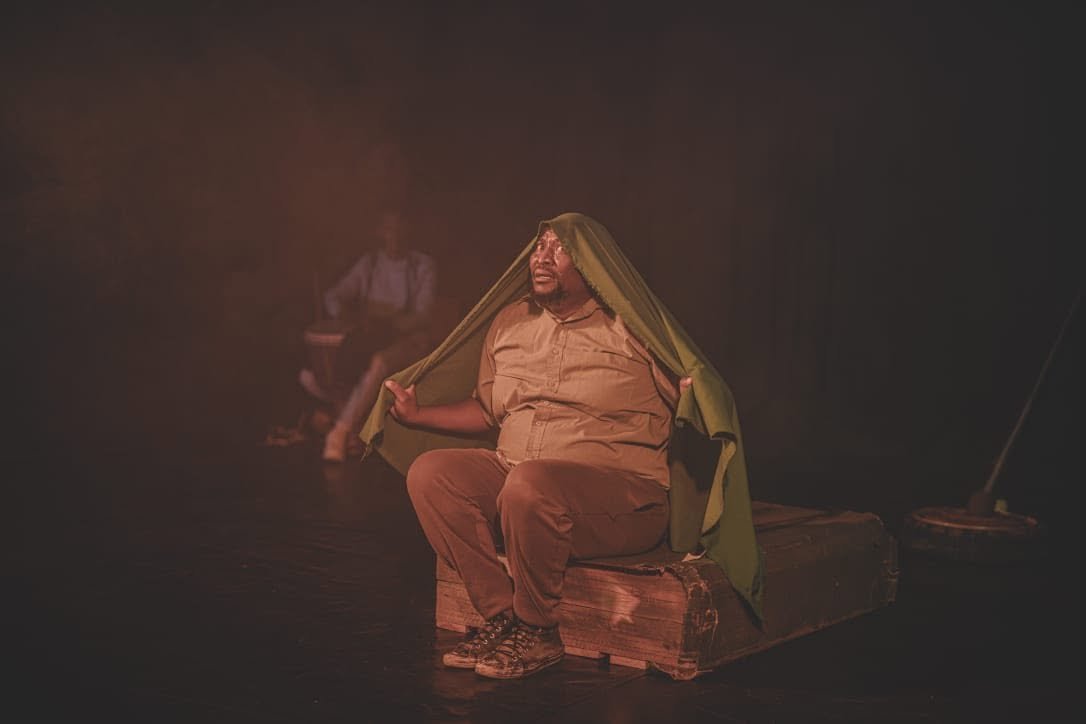
A single performer stands under a wash of light, and for the next hour the news becomes a person. That is the trick, and the achievement, of Words & Nightmares, Seiphemo Motswiri's solo show for African Tree Productions, now running at Theatre on the Square in Sandton. We are used to war arriving in our lives as headlines and casualty counts, as maps with arrows on them, as the grim arithmetic of who is winning and who is losing. Motswiri's play takes the opposite approach entirely. It shrinks the frame down to one man, one desk, and the stories he cannot stop carrying home with him.
The premise is deceptively simple. A journalist, compiling material for a book on geopolitical conflict, finds himself unable to keep a professional distance from his subject matter. Instead of researching war, he is pulled into it, dropped into the lives of the people who actually live through the events he is meant to be reporting on. Structured as three vignettes, one drawing on the conflict between Palestine and Israel, one on the war between Russia and Ukraine, and one on the Rwandan genocide, the show moves between these settings with the journalist as our guide, and increasingly, our fellow victim. He is not a neutral narrator by the end of it. None of us would be.
What struck me most was how deliberately the play refuses the language of politics. There is no attempt here to litigate borders, blame, or historical grievance, and in a moment when global conflict feels more widespread and more precarious than at any point since the Second World War, that restraint feels like a considered choice rather than an oversight.
Motswiri is not interested in who is right. He is interested in what happens to a person, an ordinary person with a family and a name and a Tuesday afternoon, when the machinery of war rolls over their life. The politics are the backdrop. The humanity is the subject.
A single body carrying many stories
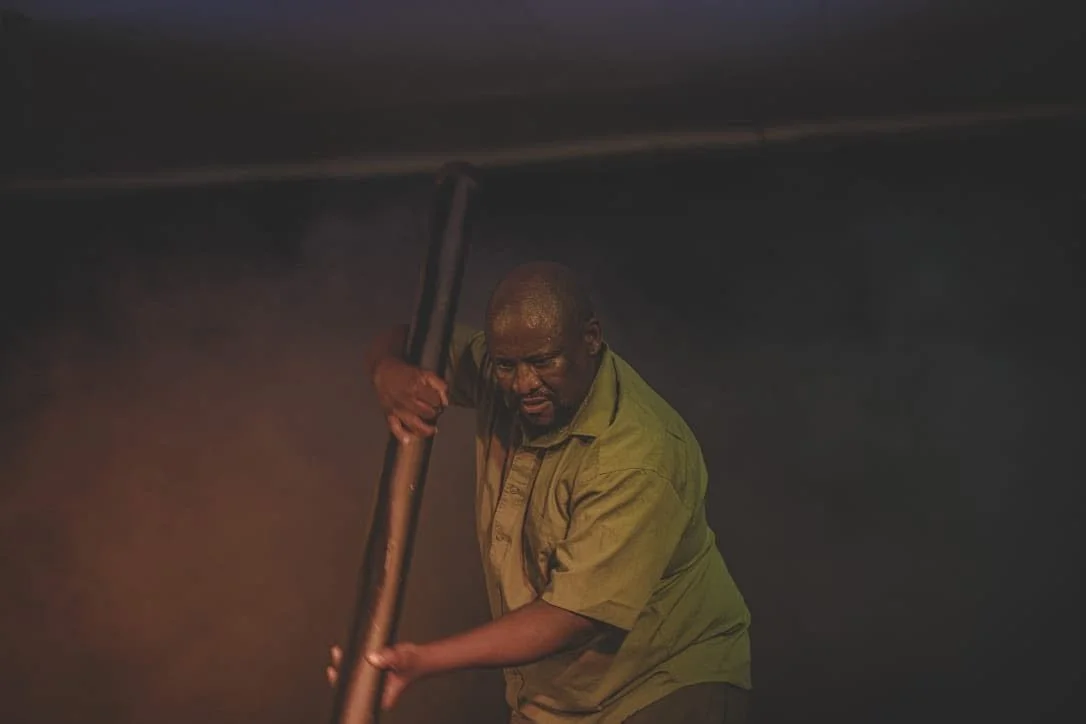
This is, of course, an enormous ask of one performer, and it is worth pausing on what Motswiri accomplishes across the evening. Moving between characters, geographies and emotional registers with almost no scenic support beyond his own body and voice, he has to make us believe, in quick succession, that we are somewhere else entirely: a family kitchen in Gaza, a stairwell in Kyiv, a hillside in Rwanda. He largely succeeds, and where the transitions are sharpest, the effect is genuinely disorientating in the best sense: you lose your footing along with him.
Themba Mkhoma's direction gives the piece its shape without ever getting in its own way. There is a clarity to the staging that lets the writing carry the weight it needs to, and a sense that every design choice has been made in service of the storytelling rather than for its own sake. That extends to Kenny Rakotsoane's music and sound design, which does a great deal of quiet, unglamorous work throughout the show. It is never intrusive, but it is constantly present, layering atmosphere and tension under the performance in a way that lets Motswiri's voice do the emotional heavy lifting while the sound handles the dread. It is the kind of design work you only really notice in retrospect, when you realise how much of the show's unease you were absorbing without quite knowing why.
None of this makes for easy viewing, and I do not think it is meant to. There were stretches where I found myself wanting to look away, not because the material felt gratuitous, but because it was doing exactly what good theatre about atrocity should do: refusing to let the horror become abstract. War, on the news, becomes numbing precisely because it is delivered in scale, in numbers too large to hold in your head. Words & Nightmares does the opposite. It insists on scale of one. A mother. A brother. A single moment of unbearable choice. That is a harder thing to sit through, and a far more honest one.
Why this matters right now
If the show has a flaw, it is one born of ambition rather than execution. Covering three distinct conflicts in a single sitting means that each vignette gets less time to breathe than it might in a piece devoted to just one, and there were moments where I wanted to stay longer in a particular story before being pulled onward to the next. But I understand the impulse behind the structure. Part of the play's argument, I think, is precisely that these are not isolated tragedies happening in three unconnected corners of the world. They are variations on the same devastating pattern, repeating itself in different languages under different flags, and the accumulation of vignettes is what drives that point home.
It is difficult, watching the news at the moment, not to feel a certain helpless distance from the conflicts unfolding across the globe. Words & Nightmares is a useful and necessary corrective to that distance. It does not offer solutions, and it is wise enough not to try. What it offers instead is a reminder, delivered with real skill and real feeling, that behind every geopolitical story there are people whose lives have been irreversibly altered, and that the least we owe them is the effort of imagining what that might actually feel like. Motswiri, Mkhoma and Rakotsoane have built a show that asks that of its audience, and asks it with craft and conviction.
I left the theatre unsettled, which I suspect was entirely the point. Not every evening at the theatre needs to leave you comfortable. Some of the most important ones are the ones that don't.