Inter Alia: A Judge, Undone

Photo: Manuel Harlan
Some plays ask you to settle in. Inter Alia grabs you by the collar and doesn't let go for a hundred and five minutes. I've sat through a fair few slow-burning productions lately, the kind that take their time easing you into a world before asking anything of you. This is the opposite. It moves like a freight train, and by the time it reaches its devastating final stretch, you realise the speed was never just a stylistic choice. It was the entire point.
Suzie Miller's follow-up to the phenomenon that was Prima Facie returns her to familiar territory: a woman in the legal profession, navigating a system she both serves and quietly interrogates. This time the protagonist is Jessica Parks, an eminent London Crown Court Judge who is, in her own words, rather good at her job. She is also a karaoke fiend, a wife with a healthy sense of mischief, and a mother trying to hold together the impossible juggling act that so many working parents will recognise. Suzie Miller and director Justin Martin, reunited after their global success together, use this domestic-professional double life as the engine of the whole piece, cutting between courtroom and kitchen with barely a pause for breath. Then an event upends Jessica's finely tuned existence, and the question of whether she can keep her family upright becomes the play's driving tension.

Photo: Manuel Harlan
A Tour de Force
None of this pace would work without an extraordinary central performance, and Rosamund Pike delivers exactly that. She is precise, articulate, and fully in command of the stage from her opening lines, switching between register and character with a control that never once feels showy. What struck me most was how emotionally exposed she allows herself to be even while maintaining that judicial precision; you believe both halves of Jessica completely, the woman who commands a courtroom and the mother who is quietly falling apart. It is a performance built on control that gradually, deliberately, loses its grip, and watching that unravel over the course of the evening is genuinely gripping theatre.
She isn't doing it alone, either. Alongside her supporting actors, including adults and kids, the production leans heavily and cleverly on live music and sound design, weaving karaoke numbers and underscoring into the storytelling in a way that never feels gimmicky. Combined with lighting that shifts mood in an instant, the staging keeps pushing the pace forward rather than letting it settle. Scene changes happen almost invisibly, courtroom becoming kitchen becoming bedroom without any of the usual theatrical throat-clearing, and the effect is one of near-constant momentum. It's a demanding way to tell a story, and an enormously effective one.
Thematically, Inter Alia sits close to territory recently explored on screen in Adolescence, in the way both works use the machinery of a legal or investigative process to pick apart questions of masculinity, parenting, and what it means to raise a son in a world that keeps shifting its expectations of him. Where Adolescence took its time letting dread accumulate, Miller's play does something almost opposite: it keeps you moving so fast that you don't notice the weight you're carrying until it's already landed. Both, in their own ways, ask uncomfortable questions about how well any of us can really know the people we love most, and about the gap between the version of ourselves we present to the world and the one that exists behind closed doors. Jessica's authority as a judge, her fluency in weighing evidence and delivering judgment, becomes almost cruelly ironic when she is forced to apply that same scrutiny to her own family and finds she cannot reach a verdict she can live with.
If there's a note of caution to sound, it's that the relentlessness of the pacing occasionally leaves little room to simply sit with a moment before the next one arrives. There were points where I wanted the production to pause, to let a particular beat land before racing on, and I suspect that will be true for other audiences too. But this feels like a deliberate trade-off rather than an oversight, and it's one I was glad the production made. The urgency is part of what makes Inter Alia so gripping, and a play that occasionally overwhelms you is, on balance, a far better problem to have than one that never quite grips at all.
What lingers most, though, isn't any single scene but the cumulative effect of watching a woman built on competence and control confront something entirely outside her jurisdiction. It's a play about the limits of judgment, professional and personal, and about how even the most capable among us can be blindsided by the people closest to them. Miller writes with real intelligence about consent, about the particular anxieties of raising boys now, and about the social judgement heaped on women trying to hold every part of their lives together at once, without ever tipping into lecture or polemic.
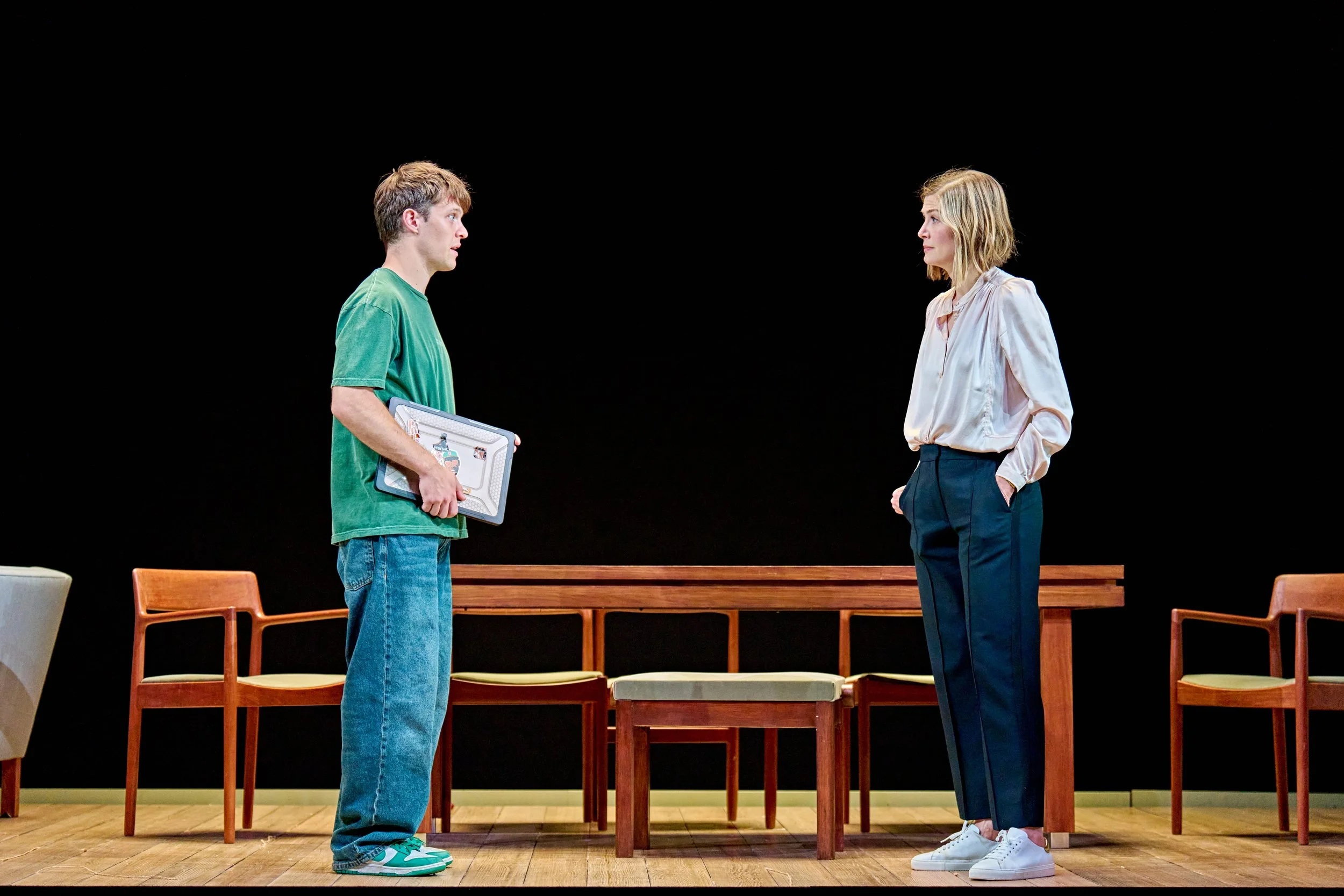
Photo: Manuel Harlan
World-Class West End Theatre on Screen in South Africa
It's also, quite simply, a reminder of what a privilege it is to have access to work like this at all. Watching a National Theatre production of this calibre on a Ster Kinekor cinema screen in Johannesburg, rather than needing to fly to London to catch it, is something I don't take for granted. NT Live continues to do something genuinely valuable in bringing world-class theatre to audiences who would otherwise never see it, and Inter Alia is a superb reminder of why that matters.