Shadows, Rhymes and Growing Up: Once Upon a Teacup
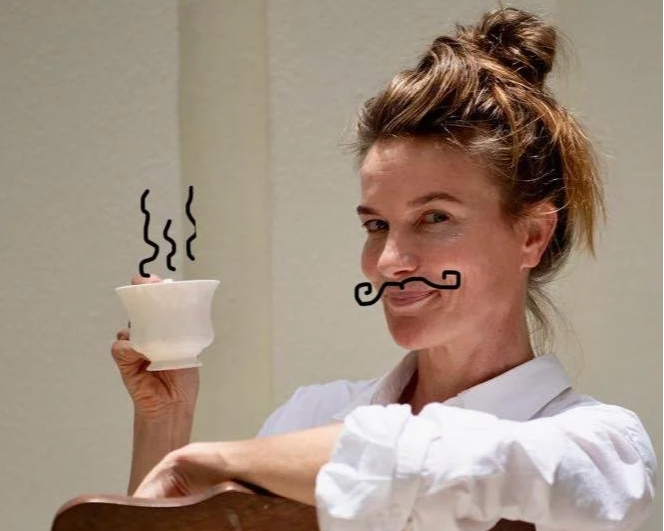
A single sheet, a lamp, and the outline of a small girl's hand: that's all it takes for the first image of Once Upon a Teacup to land, and land it does. Jessica Haines' one-woman production, now showing at Theatre on the Square, builds an entire childhood out of light and cloth and shadow, and uses that simple trick to tell a story that is at once whimsical and quietly devastating.
Haines both wrote and performs the piece, and it shows in the best possible way. This is not a script assembled at a remove from its subject; it is a deeply personal work, built with the kind of care that only comes from telling your own story, or something close enough to it that the seams don't show. The production follows Violet, a young girl growing up on a farm in KwaZulu-Natal, as she moves from the boundless imagination of childhood into the more complicated, more demanding world of adolescence and adulthood. Written entirely in rhyming couplets, it could easily have tipped into gimmick or sing-song cuteness. It never does. The rhyme sits so naturally in Haines' delivery that you stop noticing it as a device within the first few minutes; it simply becomes the way this particular story is told, the way a nursery rhyme feels inevitable rather than constructed.
The shadow work itself is the production's great strength, and it's clear why Haines pursued specialist study in the form, having trained under Norbert Götz at the Theatre der Schatten in Bamberg. Using little more than light, simple props and her own silhouette, she builds an entire farm, an entire childhood, out of shapes on a screen. There's something in shadow puppetry that reaches past the analytical part of the brain and goes straight for memory. Watching it, I found myself thinking not about the craft on display, though it is considerable, but about my own childhood: the games invented from nothing, the way an ordinary object could become anything at all if you looked at it the right way. That is the production's real achievement. It doesn't just tell you a story about imagination; it briefly hands you your own back.
The show takes its time to find its footing. The opening stretch is gentle to the point of being slow, more interested in atmosphere and rhythm than momentum, and it asks a degree of patience from its audience before the emotional stakes properly clarify themselves. Stick with it. Once Violet's story moves out of straightforward childhood wonder and into the more fraught territory of growing up, expectation and body image, the piece finds its real weight, and everything that felt unhurried in the first half starts to pay off.
It's here that Once Upon a Teacup does something genuinely brave. Without ever naming it clinically, the production gestures toward the experience of disordered eating, and it does so with a lightness of touch that never once feels exploitative or heavy-handed. One image in particular has stayed with me since the performance: a piece of cloth, slowly drawn from the mouth, the simplest of visual metaphors and, for exactly that reason, one of the most affecting things I've seen on a Johannesburg stage this year. There is no melodrama in the moment, no reaching for shock. It trusts the audience to understand, and that trust is rewarded. So many stage treatments of difficult subject matter either flinch from specificity or lean into it too hard; Haines finds the narrow, difficult middle ground where the material is honoured without being sensationalised.
James Cuningham's direction deserves real credit here too. A Lecoq-trained theatre-maker with decades of physical theatre experience behind him, he has clearly worked closely with Haines to ensure that the show's tonal shifts, from playful to painful and occasionally back again, land with clarity rather than whiplash. The staging is spare, but every choice on that stage feels deliberate. Nothing is there simply because a one-woman show needs filling out. Every prop, every shadow, every rhyme is doing work.
What lingers longest after the lights come up is the sense of a story that has been lived with, turned over, and shaped with real intention rather than dashed off for effect. Once Upon a Teacup isn't the kind of show that announces its ambitions loudly. It sneaks up on you instead, in the way the best theatre often does, through image and rhythm rather than exposition, until you find yourself somewhere you didn't quite expect to be: thinking about your own childhood, your own farm or garden or wherever your imagination first ran free, and about what exactly it is we trade away as we grow into the world's expectations of us.
It is a lovely, thoughtful night out, the kind that rewards patience in its first half with real feeling in its second, and one that confirms Theatre on the Square's knack for bringing intimate, handcrafted work to Sandton audiences. Whether you come for the shadow puppetry, the storytelling, or simply the chance to remember what it felt like to believe a teacup could hold an entire world, you're likely to leave with something of Violet's story stitched into your own.