The Opera Singer: What It Costs to Be Extraordinary
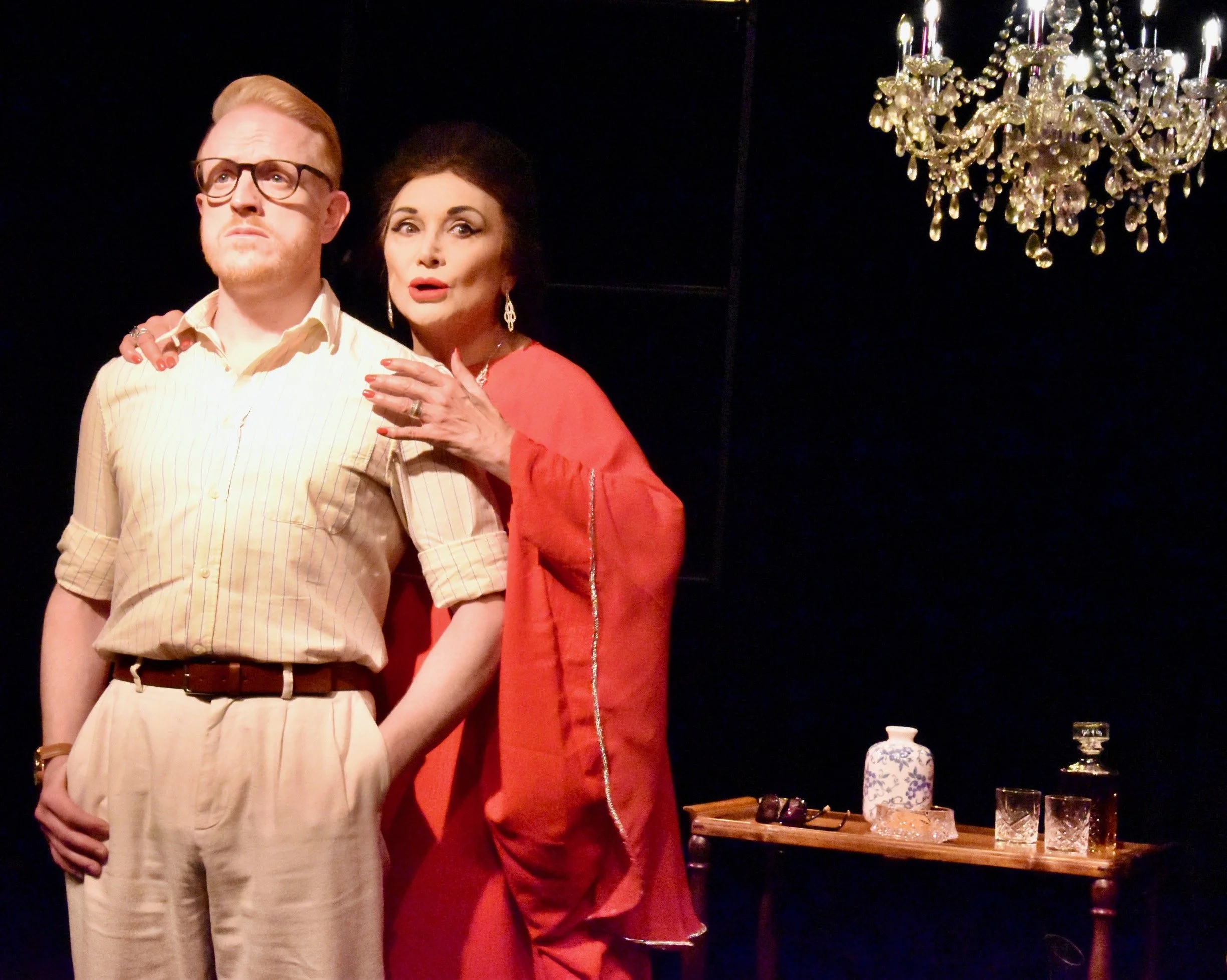
Photo: Philip Kuhn.
There is a particular kind of loneliness that only the very gifted seem to know. Not the loneliness of being unknown, but the loneliness of being seen only as what you do. I wouldn't know, of course — my own talents extend reliably as far as finding a good seat and remembering to switch my phone off. But Janna Ramos-Violante's The Opera Singer, now at Sandton's Theatre on the Square after a lauded run at the Baxter Theatre in Cape Town, understands this distinction with piercing clarity. In ninety minutes and with almost nothing on stage, it asks one of the quietest and most uncomfortable questions: what does it actually cost a person to be extraordinary?
The setup is deceptively simple. A journalist named Theo Harrington arrives to interview a celebrated operatic diva. Two chairs. A drinks trolley. A chandelier overhead. The world the play builds from these few elements, however, is anything but simple, and this is perhaps the production's most remarkable achievement. A single, intimate space becomes a dressing room, a memory, a battlefield, and a confessional, all in the same evening. The production uses a focused spotlight and opera music that only the singer herself seems to hear to do what the best theatre can do: it trusts the audience's imagination to fill in everything that the stage does not say out loud. That trust is amply rewarded.
A Dance of Revelation and Concealment
Theo comes as an admirer. He wants the truth of her, distilled into something writable, something publishable. What he gets instead is a masterclass in deflection, wit, and the occasional glimpse behind the curtain that leaves you wondering whether you really saw it at all. The play is fascinated by the ethics of this exchange: by who owns a life once it has been written about, and at what point the act of documenting another person's story becomes a kind of quiet theft. These are not questions the play answers. It is wiser than that. Instead, it puts them into action, letting the audience feel the weight of them in real time.
What keeps the evening from ever becoming heavy is the writing. Ramos-Violante's script is genuinely funny. Not funny in the broad, elbows-out way of a comedy, but funny in the way of people who use wit as a survival mechanism, as a blade they keep polished and close at hand. There were real, sustained laughs on the evening, the kind that sneak up on you in the middle of something that is simultaneously breaking your heart. It is a delicate balance to strike, and the script strikes it throughout.
Fiona Ramsay, in the title role, is formidable. She commands the stage with the kind of authority that suggests she has been building toward a role like this for the entirety of her career — which, given that it now spans more than four decades and includes some of the most demanding work in South African theatre, is saying something. Her opera singer is a creature of contradictions: imperious and wounded, hilarious and frightened, larger than life and desperately, achingly human. The performance never tips into caricature. Even at its most theatrical, it remains rooted in something recognisably true. When the armour slips, and it does, in moments that Ramsay makes feel entirely unplanned, the effect is genuinely moving.
Owain Rhys Davies, as Theo, has a task that might superficially seem easier but in practice requires just as much precision. He is the audience's surrogate in many ways: the one asking the questions we would ask, the one trying to make sense of a person who resists sense-making. Davies brings a warmth and a quiet intelligence to the role that ensures Theo never becomes merely a foil. His reactions are as carefully crafted as his dialogue. You find yourself watching his face as often as you watch hers, because what is happening there is just as interesting. The chemistry between the two actors is immediately apparent and completely convincing. Their exchanges crackle.
An Intimate Evening That Stays With You
The fourth wall is gently, knowingly porous throughout. There are moments where the singer seems to acknowledge that she is being observed, not just by Theo, but by all of us. It is done with lightness and affection rather than postmodern provocation, and it gives the whole evening a warmth and intimacy that might otherwise be harder to achieve in a play dealing with themes this thorny. You feel, sitting in Theatre on the Square's compact auditorium, that you have been invited into something private. That feeling does not leave easily.
What makes all of this land is the quality of the writing itself. Ramos-Violante constructs her characters not through exposition but through the gaps in what they say, through the questions that go unanswered, the deflections that reveal more than any confession would, and the precise, perfectly weighted line that suddenly reframes everything you thought you understood. The dialogue has the rare quality of feeling both entirely spontaneous and completely inevitable, as though every exchange could only ever have gone exactly this way. There is real craft in that. It is the kind of writing that makes you lean forward without quite realising you have done so.
The Opera Singer is the kind of theatre that justifies a night out: a work that is both thoroughly entertaining and quietly challenging, written and directed with real intelligence and performed with genuine artistry. It is also a reminder that the most profound stories are often the most intimate ones. You do not need a large stage or a large cast. You need two people in a room, something true at stake between them, and the skill to let the silence do its share of the work.
This one has all three.